
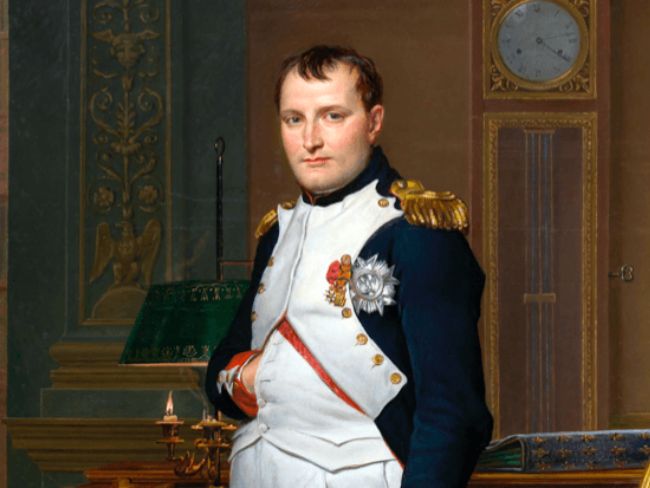
Napoleon Bonaparte carved an enduring legacy among all the figures in historical chronicles. Napoleon began his life in poverty, then advanced to become the French Emperor to establish new methods of warfare, political systems, and European diplomatic processes. Throughout his leadership, Napoleon carried out impressive wins and established essential reforms yet would eventually face disastrous defeat, which continues to thrill historians of modern times.
Early Life and Education
The island territory of Corsica gained control by France following its acquisition from Genoa during which time Napoleon Bonaparte was born on August 15th, 1769, in Ajaccio. Napoleon was the second child of Carlo Buonaparte, who worked in law practice, and Letizia Ramolino. He grew up in simple circumstances despite his high birth heritage because his childhood emerged from Corsican nationalist influences.
Napoleon received his education in mainland France during his ninth year. Before joining the military academy at Brienne, he attended the Collège d’Autun for a short time. During his time at the French school, Napoleon faced outsider status because of his Corsican heritage and pronunciation until he dedicated all his effort to studying and showed exceptional achievement in military arts and mathematics. At the age of 16, he graduated from Paris’ École Militaire, where he previously joined in 1785.
The Revolutionary Period and Early Military Career
When the French Revolution started in 1789, Napoleon seized his chance to advance in his military career. Upon beginning his support of Corsican nationalist leader Pasquale Paoli, he eventually chose to separate from the separatist movement and chose to join the French Jacobins instead.
During the Siege of Toulon in 1793, Bonaparte demonstrated his military talents through distributed artillery that produced a decisive victory for the French against British and royalist troops. By 24 years old, Napoleon received his first promotion to brigadier general status. The changes in political realities led his fortune to experience both highs and lows. During the fall of the Jacobins, Bonaparte spent some time in detention until he obtained approval from the Directory leadership.

Rise of Napoleon
Napoleon established himself in Paris as royalists launched their attempt to destroy the government in 1795. He employed artillery against the insurgent forces to break up the rebellion, which became known as the 13 Vendémiaire coup during the suppression of the revolt. His military triumphs at this moment established his distinguished standing, which earned him the command of the Army of Italy.
During his campaigns in Italy, Napoleon successfully conquered enemy Austrian forces while defeating the Piedmontese to establish French control of the region. Because of his military brilliance and motivational leadership skills, Bonaparte earned revered status throughout the nation. In 1798, Napoleon launched a daring yet unsuccessful military invasion of Egypt that sought to reduce British power within the area.
The Directory appeared vulnerable to Napoleon as he decided to come back to France in 1799. Bonaparte staged his coup d’état on November 9 (18 Brumaire), which unseated the Directory and established the Consulate under his leadership position as First Consul. His ascendancy to power as the effective leader of France started on this day.
The Napoleon Era
Napoleon announced his self-coronation as Emperor of France, which started the era of the Napoleonic Empire in 1804. The era of his governance brought extensive changes to the nation through his reform initiatives. Some of those are:
- Through the Napoleonic Code, French law enforcement underwent modernization, thus shaping many worldwide civil law systems.
- Educational reform was accepted as a structured education system aimed at building an effective bureaucracy with trained officer staff.
- The Concordat of 1801 arranged Catholic Church relations with the government by giving the state power to control religious matters.
- Economic and administrative reforms implemented standard taxation systems while creating a central banking institution known as the Banque de France.
Napoleon focused all his diplomatic strategy on fighting wars with other nations. During the Napoleonic Wars, France became engaged in military conflicts with multi-national European power blocs. After victories at Austerlitz (1805), Jena (1806), and Wagram (1809), he extended French dominance throughout Europe.
The Decline and Fall
Military excellence did not stop him from pursuing goals that were beyond his reach. An invasion of Russia by him ended disastrously for him in 1812. His army met complete annihilation because he had to fight against Russia’s harsh winter along with destructive tactics that left no resources behind while facing critical supply shortages. The Russian military victories launched a decline in his power.
A string of military losses in 1814 compelled Napoleon to surrender his throne and experience exile in Elba before returning during the Hundred Days to make a brief comeback. He fled from Elba and launched his making of history when he returned to France in 1815. His momentary comeback during the Hundred Days conflict concluded in defeat at Waterloo on June 18, 1815. After the British capture, he spent his last years on the distant Saint Helena island before his death on May 5, 1821.
Legacy
Napoleon had an undeniable impact throughout France and the world. Today, the world studies his military plans and follows his laws,, while his consolidated government principles define present-day states. Napoleon is an unforgettable historical figure because he reformed Europe through the power of his determination before eventually succumbing to defeat.
The life story of Bonaparte demonstrates the connection between ambition and strategic planning along with the temporary control of a realm that started from his Corsican beginning.
You May Also Like:


Fact Check
At BiographyVerce, we focus on providing accurate and reliable information. If you find anything misplaced or unreliable information, please contact us at support@biographyverce.com. We value your feedback.
Comments are closed