
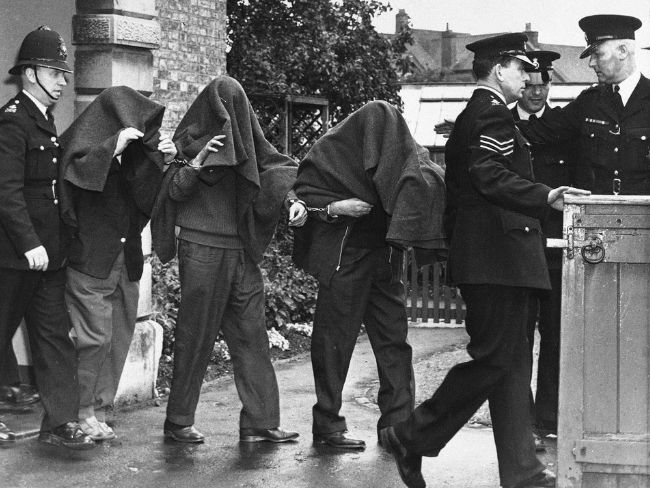
The audacious British historical crime unfolded in an early morning moment on August 8th, 1963. A gang of criminal thieves executed the meticulously planned Great Train Heist, from which they stole a massive £2.3 million worth (£30 million today). Human mistakes, together with excessive greed, led to the downfall of the thieves who carried out this perfectly planned robbery.
Opportunity of the Heist
A Travelling Post Office train departed from Glasgow and traveled to London Euston late Thursday, August 8, 1963. Postal staff on that train separated all types of mail and packages, where registered packages containing money were included. The package transport section usually contained £300,000, but the bank holiday created an extraordinary condition leading to £2.3 million being sent.
The Wrong Signal
As the train passed through Leighton Buzzard at approximately 3:00 AM, the driver, Jack Mills, spotted a red signal at Sears Crossing. Unbeknownst to him, the signal was fake—manipulated with a glove and powered by a six-volt battery. Upon stopping, co-driver David Whitby exited the train to investigate but was ambushed and thrown down a steep embankment.
Meanwhile, a masked man boarded the train and struck Mills on the head, knocking him unconscious. The robbers then uncoupled most of the train, leaving only the engine and the first two carriages, which contained the valuable cargo.
Heist at Stake
The thieves intended to operate the train from its current position up to Bridego Bridge to receive the stolen money delivery from Land Rovers at the designated hideout. The gang member designated to drive the train discovered that he lacked the ability to manage the diesel engine. The gang was forced to rouse the injured Jack Mills to continue the journey in order to complete the heist.
Within the first two carriages, postal workers were held at bay, unaware of the robbery unfolding. Meanwhile, the remaining carriages, left behind at Sears Crossing, continued their route as if nothing had happened.
The Getaway and Hideout
At Bridego Bridge, the robbers swiftly formed a human chain, unloading 120 sacks containing 2.5 tons of cash. Their efficiency was remarkable, and before fleeing, they instructed the postal staff to remain still for 30 minutes, buying themselves crucial time. Investigators later deduced that the gang must have had a hideout within a 30-minute drive, which turned out to be Letherslade Farm in Buckinghamshire.
At the hideout, the gang celebrated their success, even playing a game of Monopoly using real stolen money. However, their premature celebrations would prove costly.

The Investigation and Downfall
A massive police investigation was launched, led by the Flying Squad at Scotland Yard and senior detectives from Buckinghamshire Police. British Transport Police also played a role in gathering staff lists and potential suspects.
The gang’s biggest mistake came from their stay at Letherslade Farm. Low-flying RAF planes unnerved them, prompting them to abandon the hideout sooner than planned. A nearby resident found their sudden departure suspicious and alerted the authorities. When PC John Wooley arrived at the scene, he discovered abandoned food, sleeping bags, and most damning of all, banknote wrappers and post office sacks.
Forensic experts then uncovered fingerprints on a Monopoly board and a ketchup bottle, leading police directly to several of the culprits. One by one, the gang members were arrested.
Justice Served
The mastermind, Bruce Reynolds, evaded capture for five years but was eventually sentenced to ten years in prison. Ronnie Biggs was sentenced to 30 years but made a dramatic escape from Wandsworth Prison just 15 months later, fleeing to Brazil after stops in Spain and Australia. He remained a fugitive until voluntarily returning to the UK in 2001.
In total, the gang received a collective sentence of 307 years. Despite stealing an immense fortune, none of the criminals enjoyed a glamorous life post-robbery. Buster Edwards later ran a flower stall at Waterloo Station and was portrayed by Phil Collins in the 1988 film Buster. Tragically, he took his own life in the late 1990s. Other gang members met grim fates, with some getting involved in drug trafficking and others, like Charles Wilson, being assassinated in Spain.
A Brilliant Yet Doomed Plan
The Great Train Robbery remains one of the most legendary heists in history. While it was brilliantly orchestrated and involved no firearms, the gang’s ultimate undoing was their inability to cover their tracks. Fingerprints, greed, and overconfidence led to their downfall. Their story serves as a reminder that, no matter how well-planned a crime may be, mistakes and human nature often lead to justice prevailing.
You May Also Like:


Fact Check
At BiographyVerce, we focus on providing accurate and reliable information. If you find anything misplaced or unreliable information, please contact us at support@biographyverce.com. We value your feedback.
Comments are closed